Machine tool bellows
Protect your people and your machines
If your shop is anything like ours, every piece of equipment on the floor needs protection. And we have the answer. Constructed using lightweight materials, bellow covers are designed to protect guide-ways and machine components from external influences in tight places.
Hennig's bellow product range includes simple designs for dust protection to sophisticated designs featuring extension systems, and/or lamellas and special models. Additionally, some bellows are used to protect employees against encroachment and crushing.
Our industrial bellows are made exclusively from high-quality plastic fabrics and foils. We select the cover material and processing according to the ambient conditions in your shop. Decisive factors are the mechanical and thermal strain of the bellows as well as the type of swarf, chips, and aggressiveness of the agents used.
The appropriate bellow type depends on the operating conditions, including the mechanical and thermal load on the bellows, the types of chips, and types of materials present during the operation. Work with one of our specialists to ensure you have the proper bellow for your application.
Bellow cover products
Coated Fabric Bellows
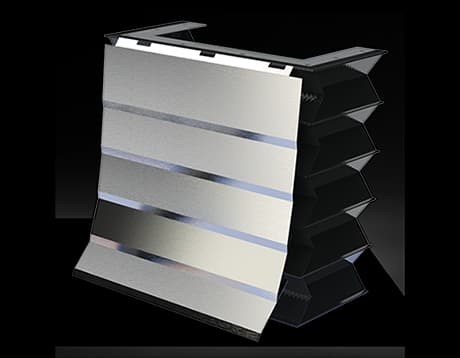
Fixed Steel Lamella Bellows
Hinged Steel Lamella Bellows
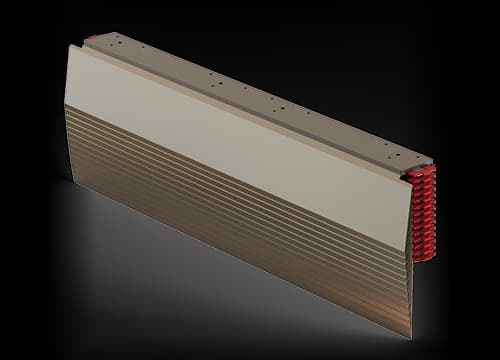
Modular Steel Lamella Bellows
Molded Rubber Bellows
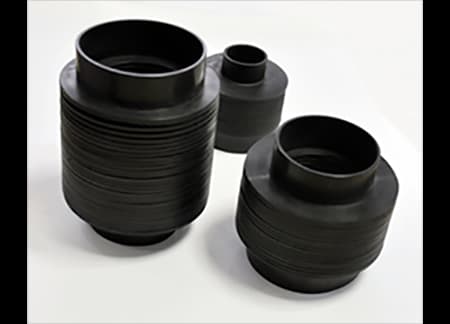
Round Bellows
Rubber Disk Bellows
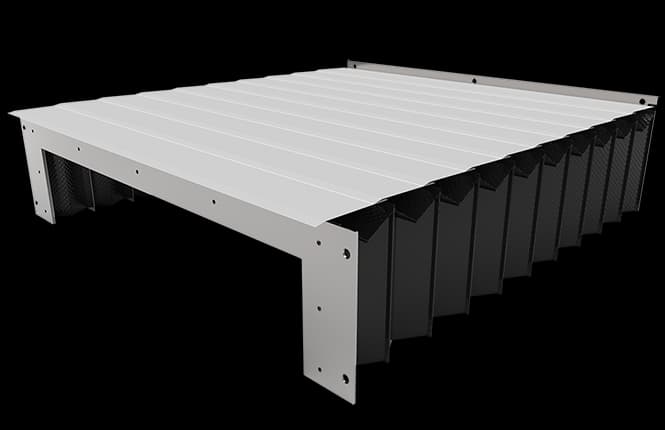
Machine Roof Bellow Covers
Bellow options
The dynamic properties of modern drives make heavy demands on all bellows. With Hennig, you can adapt every detail of the friction, extension and durability properties of your bellows to your requirements.
- End Frames: End frames, mostly made from steel or aluminum, connect the bellows with the machine. Hennig offers various fastening solutions for the adaptation to different bellows and machine interfaces.
- Intermediate Frames: Intermediate steel frames are used to connect the various elements, especially when extension limit systems are required. The intermediate frames are fastened to the bellows with a clamping rail. The intermediate frames can be guided by either plastic or brass rollers or gliders.
- Guide Frames: The guide frames provide the bellows with the necessary stability and enable a precise operation, even at high speeds. They are made from PVC and are directly welded to the cover. The shape of the frame is adapted by Hennig to the design required.
- Rollers: Rollers are used in large and heavy bellows. They minimize friction and ensure excellent running properties.
- Coupling Rail: Necessary for medium and large bellows with a high number of folds in order to connect the single bellow elements together. Connected inside and outside.
- Lamellas: Fixed or hinged, stainless steel lamellas can be added to protect the bellows against hot, sharp-edged swarf, or mechanical strain.
- Scissors: Scissors are used for high traversing speeds. This allows an even extension of all elements across the whole extension length. As a result, the folds are less strained and the durability of the bellows is prolonged.
- Half-Scissors: With half-scissors, the individual elements can be extended successively depending on the necessary extension length. Since the folds are not loaded up to the theoretically possible extension limit, it also has better durability.
Assembly options
Heat Sealed
The optimum design for bellows is the heat-sealed version. The cover material and PVC guide frames are permanently joined. The connection of the bellows material and the guide frames ensures maximum loading capacity and absolute tightness against liquids such as cooling or grinding agents.
Stitched
Due to their robust design, these bellows have a long and reliable service life, even under extreme mechanical and dynamic strain. The temperature resistance of these bellows can be increased to approx. 400 °C (752 °F) when using an aluminized fabric.
Glued
These bellows consist of up to three foils glued together in sandwich construction. Due to the special gluing of materials, these bellows provide maximum protection, even against liquids.
Frequently asked questions
Why do you need bellows?
Bellows are used as machinery protection in a wide variety of industries. Their primary use is to protect guideways and other precision equipment from outside contaminants and occasionally to keep contaminants contained. They often have a secondary purpose as a visual barrier to protect pinch points and other areas where machinery could prove dangerous to a user.
What types of bellows are there?
Hennig sells and designs different types of bellows for different applications. These bellows could range from simple heat sealed bellows to run on a rail to a sewn round bellow to protect a ball screw or a bellow with stainless steel shims to protect the bellow from hot chips or molded bellows to protect a piston. Bellows can literally come in all shapes and sizes. These bellows could range from: simple heat sealed bellows that run on a rail; a sewn round bellow to protect a ball screw; a bellow with stainless steel shims to protect the bellow from hot chips; molded bellows to protect a piston.
Which type of bellow is the right one?
You may already know the correct bellow for your application but, if you don't, then you can talk to our engineers or sales directors who will guide you through materials, types of bellows, and other criteria depending on the conditions or the application.